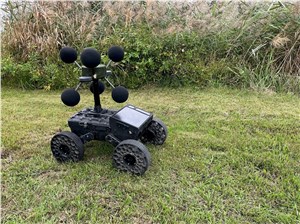
Invariant Corporation and Hyperion Technology Group were selected to team with Swarmbotics as part of the Jailbreak NANO ACE effort, integrating their collaborative FireFLY passive acoustic sensing capability onto Swarmbotics’ autonomous FireAnt small unmanned ground vehicle (sUGV). Throughout the effort, FireFLY operated alongside multiple complementary sensor modalities, demonstrating the ability to contribute passive acoustic detections and tracks to a broader, integrated sensing architecture.
The demonstration showcased the use of autonomous ground platforms to deploy and maneuver passive acoustic sensors in support of counter-UAS (CUAS) operations, while integrating FireFLY detection, tracking, and classifying into a broader multi-modal sensing architecture.
“This effort demonstrated what we believe is one of the greatest strengths of passive acoustic sensing: the ability to provide another layer of awareness without adding an active signature. By combining FireFLY with an autonomous ground platform and integrating the resulting data into IBCS-M, we were able to show how acoustic sensing can become part of amuch larger, networked C-UAS architecture,” says CEO, David Anderson.The team conducted an operational assessment to evaluate this type of solution to the growing UAS threat. During the assessment, FireFLY sensors mounted on FireAnt were successfully maneuvered and positioned through the Integrated Battle Command System-Maneuver (IBCS-M) C2 architecture, while detecting, tracking, and classifying UAS using passive acoustic sensing simultaneously alongside other modalities.
The FireAnt sUGV provided a natural host platform for FireFLY. Its onboard power and communications architecture supported the sensor with minimal additional burden, while its autonomous mobility allowed the system to maneuver acoustic sensors into the correct position to detect and track.
The rapidly evolving UAS threat is increasingly defined by small, low-cost, low-altitude systems that exploit terrain, clutter, autonomy, and nontraditional control methods to avoid detection. These threats can be deployed at scale, operate with minimal electronic signatures, and challenge counter-UAS architectures that rely primarily on radar or RF detection. FireFLY-AOv3 provides an independent detection layer that complements radar, EO/IR, and RF sensors, alerting and cueing other sensors or effectors when low-altitude flight, terrain, clutter, radar masking, or RF-silent and wire-guided control methods limit active systems.
FireFLY-AOv3 provides a rapidly deployable, low-SWaP-C, passive acoustic sensing capability that detects, classifies, geolocates, and tracks small UAS and weapons-fire threats in real time. The self-calibrating sensor delivers 3-D threat location, including elevation, while combining advanced signal processing and AI/ML to improve classification and reduce false alarms. Built on ruggedized TRL-9 hardware, FireFLY-AOv3 is power, communications, and C2 agnostic, with demonstrated integration across multiple platforms, networks, and command-and-control architectures.
The Fireant will be displayed with the FireFLY at the U.S. Army’s Pathway for Innovation and Technology (PIT) booth at AUSA on October 12–14, 2026, at Walter E. Washington Convention Center, Washington, D.C.