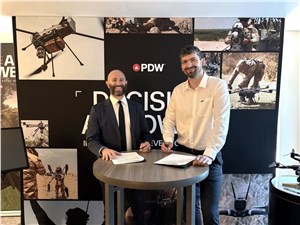
American defense technology company Performance Drone Works (PDW) has entered into a memorandum of understanding with The Fourth Law and Odd Systems to advance U.S. development, qualification, and potential production of Ukrainian thermal camera technology. The collaboration includes Odd Systems, developer and manufacturer of the Kurbas camera family, and establishes a framework to evaluate U.S. thermal-sensor manufacturing as part of Project Foundation.
The collaboration marks a step in PDW’s strategy to build domestic capacity for critical drone and robotics components, a central objective of the previously announced conditional loan commitment of up to $820 million from the Department of War’s Office of Strategic Capital (OSC). It also advances PDW’s goals of bringing battle-tested capabilities to American and allied warfighters: identify superior technology wherever it originates, adapt it to U.S. requirements, and establish the qualification, production, and support needed to field it at scale.
“Delivering airpower at scale requires a reliable supply of the critical components inside every aircraft,” said James Slider, CEO of PDW. “The Fourth Law and Odd Systems are developing and refining technology against the demands of today’s battlefield. We see an opportunity to turn those hard-earned lessons into enduring U.S. industrial capability.”
Bringing battle-tested thermal imaging into a U.S. qualification and production pathway
Odd Systems develops and manufactures thermal cameras shaped by the demands of Ukrainian combat operations. Thermal imaging helps operators see at night and gives unmanned systems a critical source of information for reconnaissance and perception.
Kurbas is the most widely used Ukrainian-made thermal camera on the frontline today. It is supplied to more than 200 drone manufacturers and flies on many types of unmanned systems, from Shahed interceptors to strike drones. Odd Systems builds its cameras around the thermal sensor, developing the electronics, image processing, and low-level firmware in-house.
The initial work would focus on jointly developing and evaluating a U.S.-compliant, export-ready configuration of the Kurbas 640 camera family. Subject to successful evaluation and definitive agreements, the companies intend for PDW to become the primary U.S. manufacturing partner for Kurbas cameras requiring domestic production. The proposed pathway would support integration into PDW platforms and distribution of U.S.-manufactured cameras to other U.S. customers.
The companies also intend to explore a separate U.S. thermal-sensor manufacturing capability based on technology from The Fourth Law and Odd Systems. This would extend the potential industrial contribution beyond camera assembly to the sensing technology at the heart of thermal imaging systems.
That capability would build on Project Foundation, the semiconductor initiative The Fourth Law and Odd Systems launched on October 9 to mass-produce uncooled long-wave infrared (LWIR) sensors, also known as microbolometers, in Europe and the United States.
“Ukraine taught us the hard way that you can’t build drones at scale on components someone else controls,” said Yaroslav Azhnyuk, CEO of The Fourth Law and co-founder of Odd Systems. “Kurbas cameras were built and proven at the frontline. With PDW, we can bring that technology to American platforms and, through Project Foundation, build the thermal-sensor supply chain behind it on U.S. soil.”
Advancing the industrial strategy behind the OSC commitment
Announced in July 2026, the conditional OSC loan commitment is intended to expand domestic manufacturing of critical technologies and components for drones, robotics, and autonomous systems while reducing reliance on foreign-controlled supply chains.
The collaboration with The Fourth Law and Odd Systems advances the vision-systems element of that strategy. It follows PDW’s acquisition of Vanteon, which expanded the company’s communications, radio-frequency, and embedded-systems engineering capabilities. Together, these steps strengthen PDW’s ability to integrate mission critical technologies while developing a broader domestic component supply base.
“This collaboration is a concrete step toward the vision behind our OSC commitment: build the components our own platforms need and strengthen the supply base for the broader American drone industry,” continued Slider.
The OSC loan remains subject to negotiation of definitive documentation, financial close and applicable closing requirements. The MOU establishes a non-binding framework and sets forth the companies’ business intent; development, manufacturing, distribution, and sensor-production activities remain subject to evaluation, applicable regulatory requirements and approvals, and separate definitive agreements.