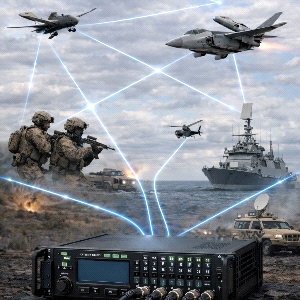
Tactical Communication Systems - Market and Technology Forecast to 2034
Market forecast by Region, Domain, and Lifecycle phase. Country and Programme Analysis, Market and Technology Overview, Opportunity Analysis, and Leading Company Profiles
Market forecast by Region, Domain, and Lifecycle phase. Country and Programme Analysis, Market and Technology Overview, Opportunity Analysis, and Leading Company Profiles
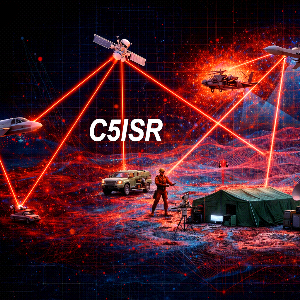
A shift from command-centric operations to data-driven decision-making will define the emerging era of warfare. Modern battlefields are increasingly shaped by the rapid expansion of sensors, unmanned systems, electronic warfare activities, and cyber operations, all generating vast volumes of data that must be processed, analysed, and acted upon in real time. Traditional command and control systems, often platform-centric and operating within closed architectures, are becoming inadequate for managing this complexity. In this context, C5ISR has emerged as the foundational framework enabling militaries to connect sensors, platforms, networks, and decision-makers into an integrated operational environment capable of delivering faster and more informed responses.
This C5ISR study focuses on linking C5ISR technologies directly to defence programmes, contracts, and budgetary commitments rather than viewing C5ISR purely as a conceptual or technological development. The analysis integrates programme timelines, capability development stages, procurement pathways, and development as well as acquisition costs to present realistic adoption trajectories. By examining modernisation initiatives in command and control systems, tactical communications, ISR integration, cyber capabilities, and battlefield digitisation, the study positions C5ISR as the central architecture enabling modern multi-domain operations.
By analysing material dependencies alongside technology development and procurement activities, the study highlights supply-chain vulnerabilities, geopolitical exposure, and industrial resilience considerations that may influence the pace and structure of future C5ISR deployments.
The findings indicate that the C5ISR domain is evolving from fragmented command, communication, and intelligence systems into integrated operational ecosystems that underpin modern military operations. Armed forces are moving away from isolated command systems and standalone ISR platforms toward interconnected architectures where sensors, communications networks, computing infrastructure, cyber capabilities, and decision-making frameworks operate as a unified system. In this evolving construct, C5ISR enables seamless coordination between surveillance assets, electronic warfare systems, command networks, unmanned platforms, and combat systems, providing the situational awareness and decision advantage required in increasingly complex operational environments.
Looking ahead, the coming decade will favour organisations capable of delivering integrated C5ISR ecosystems rather than standalone technologies. Success will depend on combining resilient communications networks, secure cyber infrastructure, advanced computing and data processing capabilities, sensor fusion technologies, and interoperable command-and-control systems. As militaries seek to manage expanding volumes of battlefield data, coordinate operations across multiple domains, and maintain operational resilience in contested environments, C5ISR is set to become the foundational architecture enabling future military operations and defence modernisation efforts.
Complete the form below and we will send sample pages for this study. Please use a business email address.
Explore additional studies connected to this study.
Market forecast by Region, Domain, and Lifecycle phase. Country and Programme Analysis, Market and Technology Overview, Opportunity Analysis, and Leading Company Profiles
Market forecast by Region and Platform Type. Country Analysis, Market and Technology Overview including Critical Raw Materials, Opportunity Analysis, and Leading Company Profiles
Market forecast by Region, Type, Application, and End-User. Market and Technologies Overview, Country and Impact Analysis, and Leading Companies
Market forecasts by Region, Platform, End-User, and System Element. Country Analysis, Market and Technology Overview, Opportunities and Impact Analysis, and Leading Company Profiles
Market forecasts by Regions, Systems, Equipment, and by Force Type Market/Technologies Overview, Market trends, Country Analysis, and Leading Companies

Market forecasts by Region, Airport Size, Offering, and hard/software. Country Analysis, Market Dynamics, Market and Technology Overview, Trends overview, Opportunity and COVID-19 Analysis, and...