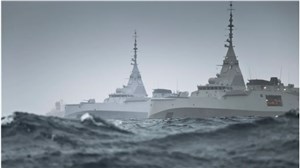
In a world facing new challenges, Naval Group offers high-performance, reliable and scalable vessels to enable navies to preserve their sovereignty in seas around the world. The FDI family represents a prime example: a tried-and-tested, scalable platform available in various configurations to meet the varying needs of fleets.
Designed for high-intensity, long-duration operations at sea, the defence and response frigate (FDI) has demonstrated its capabilities in the most demanding environments, notably during the long-term deployment of the Amiral Ronarc’h in early 2026. Its endurance and performance are largely down to its design and its inverted bow, which ensure excellent seaworthiness and maximise the performance of its weapon systems.
Building on the globally recognised excellence of the French multimission frigate (FREMM) in the field of anti-submarine warfare (Hook’em Awards), the FDI is notably equipped with Thales’ CAPTAS-4 sonar and Naval Group’s MU90 torpedo. It uncompromisingly combines these features with world-class air defence capabilities: a Sea Fire digital radar suite and Sentinel electronic warfare system from Thales, mounted on a single mast providing continuous 360° surveillance over vast areas.
Informational and decision-making superiority
These state-of-the-art sensors feed data into the Setis combat management system (CMS), which has been tried and tested in combat. This makes it possible to establish a comprehensive and reliable multi-domain tactical situation, in real time, in the face of multiple threats. The frigate is a real pioneer in the digital fieldAt the cutting edge og digital technology, the frigate, using a distributed architecture and cybersecure data centres to process and enrich data, thereby enhancing the crew’s informational and decision-making superiority. Its multi-spectrumradio and satellite connectivity capabilities, redundant and resilient connectivity capabilities make it a true interoperability hub within coalition operations, positioning it to play a central role in future hybrid fleets.
Adopted by the French Navy, which ordered a fifth vessel in March 2026, the FDI has also attracted interest from Greece and Sweden.
Growing needs, a vessel that adapts
As a multipurpose and scalable frontline frigate, the FDI adapts to the needs of each navy whilst remaining open to future technological developments. Its digital architecture gives it tremendous potential for growth throughout its lifespan.
Building on the success of the FDI, Naval Group is now developing variants to create a veritable family of frigates based on this tried-and-tested platform. The aim is to provide navies with capabilities addressing their current needs, while enabling them to upgrade their vessels to meet the demands of the future.
There are many such variationsThese variations can take several forms, offering minimal risk whilst maximising effectiveness: more multi-domain weapons carried on board, both defensive and offensive; greater flexibility and modularity with the integration of mission containers (loitering munitions, drone-intercepting drones, missiles, laser weapons, etc.); as well as greater autonomy, carrying capacity and command capabilities.