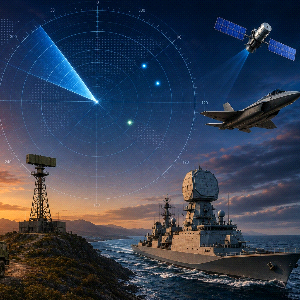
Military radar systems have evolved into one of the most critical technologies in modern warfare, enabling real-time surveillance, target acquisition, threat tracking, missile guidance, and integrated air and missile defence across land, naval, airborne, and space domains.
Over the years, military radar systems have evolved from standalone surveillance sensors into intelligent, multifunction sensing platforms that form the backbone of integrated air and missile defence, network-centric warfare, and multi-domain operations.
In a major market shift, Active Electronically Scanned Array (AESA) radars have been replacing mechanically scanned radars for nearly three decades. Defence forces are upgrading legacy fourth-generation aircraft, naval platforms, and ground-based air defence systems with advanced AESA radars to extend platform service life and improve operational effectiveness.
The major transformation today is no longer the replacement of mechanically scanned radars with AESA. That transition has largely been underway since the early 2000s and is now mature across advanced air, naval and ground platforms. Instead, the market has entered a second modernisation cycle, where first-generation AESA radars are themselves being replaced or upgraded with software-defined, GaN-based, multifunction radar systems designed for network-centric and multi-domain warfare.
Defence forces are upgrading legacy fourth-generation aircraft, naval platforms, and ground-based air defence systems with advanced AESA radars to extend platform service life and improve operational effectiveness.
The role of military radars is also expanding from dedicated surveillance or fire-control functions to multifunction systems capable of simultaneously performing surveillance, target tracking, missile guidance, electronic warfare support, and communication tasks, reducing the need for multiple standalone sensors.
Furthermore, the integration of artificial intelligence (AI), electronic warfare capabilities, and network-centric architectures is transforming radars into intelligent sensing nodes that can share real-time data across joint force networks, enabling faster and more informed decision-making. Growing security challenges, including the proliferation of counter-unmanned aerial systems (C-UAS), hypersonic weapons, cruise missiles, and advanced integrated air and missile defence requirements, are further accelerating investments in next-generation military radar systems capable of detecting, tracking, and engaging increasingly complex and high-speed threats.
Military Radar Systems – Market and Technology Forecast to 2034 focuses on the current and next generation of advanced military radar systems. It analyses the market dynamics associated with the transition from first-generation AESA radars to software-defined, GaN-based, multifunction radar architectures, as well as the integration of artificial intelligence, advanced signal processing, sensor fusion, and network-centric operations. The study evaluates how defence forces are modernising legacy platforms with advanced radar upgrades while investing in next-generation sensing capabilities to address evolving operational requirements.
Covered in this Study
- Overview: Military radar technologies and forecast of the market during 2026-2034, including highlights of the demand drivers, trends, and challenges. It also provides a snapshot of the spending with respect to regions as well as segments.
- Market Dynamics: Insights into the technological developments in the military radar market and a detailed analysis of the changing preferences of governments around the world. It also analyses changing industry structure trends and the challenges faced by the industry participants.
- Programmes Analysis: Details of the programmes in each segment expected to be executed during the forecast period.
- Segment Analysis: Insights into the various systems market from a segmental perspective and a detailed analysis of factors influencing the market for each segment.
- Regional Review: Insights into modernisation patterns and budgetary allocation for top countries within a region.
- Regional Analysis: Insights into the systems market from a regional perspective and a detailed analysis of factors influencing the market for each region.
- Opportunity Analysis: Analysis of the military radar market based on compound annual growth, programme opportunities, and inventory replacement.
- Competitive Landscape Analysis: Analysis of the competitive landscape of this industry. It provides an overview of key companies, together with insights such as key alliances, strategic initiatives, and a SWOT analysis.
Segmentation
The Military Helicopters market is segmented by Region, Size, and Application.
Region
- North America
- Europe
- Asia-Pacific
- Middle East & Africa
- Latin America
Function
- Surveillance
- Tracking
- Imaging
- Multi
Domain
- Airborne
- Naval
- Land-Based
- Space-Based
Mobility
Who will benefit from this study?
This study is designed for organisations involved in the development, procurement, integration and support of military radar systems.
- Radar Manufacturers and System Integrators – Identify future procurement opportunities, technology trends, competitive positioning and regional growth markets.
- Defence Electronics and Component Suppliers – Understand demand for AESA modules, GaN semiconductors, antennas, RF components, processors and radar software.
- Defence Ministries and Procurement Agencies – Benchmark capabilities, assess emerging technologies and evaluate global procurement and modernisation trends.
- Platform Manufacturers – Support radar integration strategies for aircraft, naval vessels, air defence systems, vehicles and unmanned platforms.
- Investors and Consultants – Assess market growth, competitive dynamics, investment opportunities and future demand across key regions and radar segments.
The study provides valuable insights for strategic planning, business development, product roadmaps and investment decision-making across the global military radar industry.
Related studies